

What a BSL‑3 Laboratory Study Actually Showed
Short answer
Yes. Under controlled laboratory conditions, HEPA air cleaners removed infectious SARS‑CoV‑2 from the air with extremely high efficiency, reaching greater than 99.97% removal after sufficient air turnover. A popular claim is now backed by direct viral measurements, not theory.
This article explains what was tested, what was proven, and what the findings mean in real-world settings—without hype or confusion.
Why This Study Mattered
By 2022, it was already clear that COVID‑19 spreads through airborne particles, not only large droplets. Buildings, schools, hospitals, and homes turned to air cleaners with HEPA filters—but there was a glaring gap:
Most evidence showed HEPA filters remove particles, not infectious virus.
This study, published in mSphere in August 2022, directly measured live, infectious SARS‑CoV‑2 in air before and after HEPA filtration. That distinction matters.
Who Conducted the Research
The work was led by researchers at:
University of Wisconsin–Madison
University of Tokyo
National Institute of Infectious Diseases (Japan)
The team included Yoshihiro Kawaoka, one of the world’s most respected virologists. The experiments were conducted in a biosafety level 3 (BSL‑3) laboratory, the standard for handling infectious SARS‑CoV‑2.
What Exactly They Tested
Experimental setup
Live SARS‑CoV‑2 was aerosolized into a sealed test chamber
Aerosols mimicked real-world airborne transmission
A commercial air cleaner with a HEPA filter circulated air in the chamber
Researchers sampled air for infectious virus, not just RNA or particles
This matters because inactive viral fragments are easy to remove; live virus is what causes infection.

What “Ventilation Volume” Means
Ventilation volume refers to how many times the total volume of air in the room passes through the filter.
1 ventilation volume = all air filtered once
2 volumes = air filtered twice
7 volumes = air filtered just over seven times
This is key to understanding how quickly filtration works.
The Results (Straight Numbers)
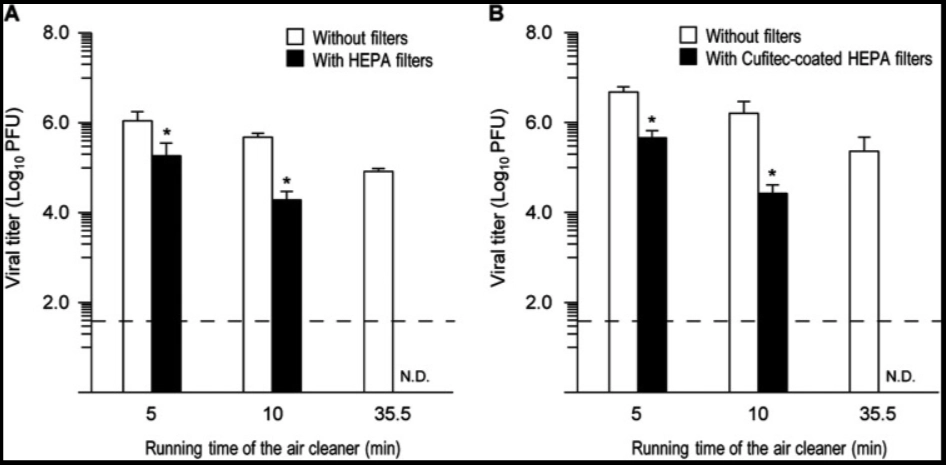
Removal of infectious SARS‑CoV‑2 from air
1 ventilation volume:
85.38% of infectious virus removed
2 ventilation volumes:
96.03% removed
7.1 ventilation volumes:
>99.97% removed
This demonstrates continuous, time‑dependent removal of infectious virus.
In practical terms: the longer the air cleaner runs, the safer the air becomes.
What About “Antiviral-Coated” HEPA Filters?
The researchers also tested a HEPA filter coated with a copper-based antiviral compound.
Findings
Virus capture efficiency was comparable to a standard HEPA filter
No meaningful additional reduction occurred once virus passed through the filter
Main benefit came from mechanical filtration, not chemical inactivation
Plain conclusion
Adding antiviral coatings did not significantly improve airborne SARS‑CoV‑2 removal beyond what HEPA filtration already achieves.

What This Study Proved—Clearly
This research showed, quantitatively and directly, that:
HEPA filters remove live, infectious SARS‑CoV‑2 from air
Removal efficiency depends on air turnover, not marketing claims
Standard HEPA filters work as well as antiviral-coated versions for airborne virus removal
This is among the strongest experimental confirmations of HEPA filtration for COVID‑19 risk reduction.
What This Does Not Mean
Important limitations:
This was a controlled laboratory experiment
Real-world spaces have airflow dead zones, human movement, and reinfection sources
Filtration reduces risk—it does not make indoor spaces risk‑free
HEPA filtration is a layer, not a standalone solution.

Practical Takeaways for Real Spaces
For homes, classrooms, offices, clinics
Use true HEPA (not “HEPA‑like”)
Size the air cleaner correctly for room volume
Run it continuously when people are present
Focus on air changes per hour (ACH), not just filter brand
Antiviral coatings are optional, not essential
What actually matters most
Clean air delivery rate (CADR)
Placement to avoid stagnant air pockets
Consistent operation
Why This Paper Still Matters
Many claims about air cleaners rely on particle physics or modeling. This study:
Used live virus
Measured infectivity, not assumptions
Provided quantitative performance data
It set a clear benchmark for what HEPA filtration can achieve against airborne viral pathogens.
Bottom Line
HEPA air cleaners, when properly sized and continuously operated, are highly effective at removing infectious SARS‑CoV‑2 from the air. This is not a theory. It was measured directly under the most rigorous laboratory conditions available.
For anyone serious about indoor air safety, this study provided the evidence needed to move forward with confidence.
Citation
Ueki H, Ujie M, Komori Y, Kato T, Imai M, Kawaoka Y.
Effectiveness of HEPA Filters at Removing Infectious SARS‑CoV‑2 from the Air.
mSphere. 2022;7(4):e00086‑22.
DOI: 10.1128/msphere.00086-22
PMCID: PMC9429918

Comments